Masking the fine-tuning loss: does RandAR's clustering move off colour?
The previous piece found that a pretrained model's clusters ImageNet mostly by predominant colour, with a fainter colour-independent content axis. Colour is a low-level feature. Can we suppress it and surface the higher-level structure by masking the loss?
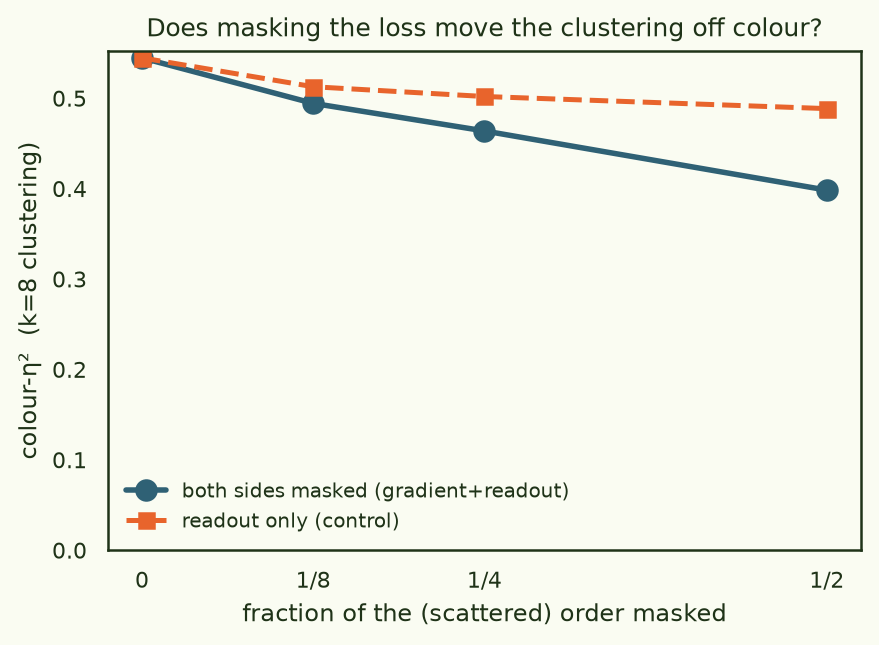
What "masking" has to mean. The natural idea — only score the last part of the image — is an image analogue of masking the loss on the first N tokens of a text: those early tokens are ~unpredictable by principled means, and once ~a quarter of the (scattered) image is shown the high-level content is fixed and the rest is predictable by induction/completion. But masking must apply to the fine-tuning, not just the measurement. Our first attempt (the signal-geometry piece, and the toggle on the previous page) masked only the readout while the SGLD perturbation still targeted the full loss — so the landscape being probed was unchanged. Here we mask the first (scattered) tokens of the random order on both the perturbation gradient and the readout, and re-sample the posterior per masking level. This piece supersedes the readout-only masking results.
Masking the first (scattered) tokens of the fine-tuning loss pulls the clustering off colour: colour-η² falls from 0.54 (no masking) to 0.40 at 1/2-masking.
§1Setup
- model
- pretrained RandAR-L 0.3B (ImageNet-256), LlamaGen VQ (256 tokens).
- masking
- at level m ∈ {0, 1/8, 1/4, 1/2} the first m tokens of each image's random order are masked (a scattered subset), and the loss — on both the SGLD gradient and the probe readout — is the NLL of the retained tail, magnitude-matched so the temperature is constant across levels. 0-masking is the standard BIF.
- BIF
- one localised sweep per masking level over all 0.3B params (4 chains × 2 seeds), block-centred covariance, on the same 500 held-out probes as the previous page.
- reproducibility
- seed-to-seed off-diagonal r per level — 0:0.5303, 1/8:0.4344, 1/4:0.4313, 1/2:0.4356 — moderate, as on the previous page; read the clusters as real-but-soft.
- control
- readout-only masking (full-loss gradient, tail readout) from the previous run, to isolate what masking the perturbation adds.
§2The splitting diagrams, down the masking sweep
Cluster hierarchy of the 500 probes (k=2→32, top→bottom), nodes tinted by dominant colour; hover any box for member images (click to pin, Esc to dismiss). Toggle the masking level:
§3Does masking move the clustering off colour?
Quantify each hierarchy by colour-η²: the fraction of image-colour variance explained by the k=8 clustering (1 = clusters are colour-pure, 0 = colour-blind).
§4What the tail axis looks like
The same per-level clusterings with colour deflated out — the content axis that the masked loss emphasises. Group-tinted for legibility; hover for member images.
§5Reading this honestly
The gate is moderate (~0.5), so gross structure is stable across seeds but individual assignments are soft. The colour axis is partly the VQ tokeniser's doing. The point of this page is methodological: masking must change the fine-tuning, not just the measurement — and it supersedes the earlier readout-only masking in this thread.
Reader-requested: do the RandAR 0/1/8/1/4/1/2-masking experiment correctly (mask both the input and output sides of the BIF) and plot the splitting diagrams. Supersedes the readout-only masking on the signal-geometry and colour⊗content pages.
Model: RandAR-L 0.3B, ziqipang/RandAR + LlamaGen VQ. Code:
randar_pretrained_bif.py (masked gradient), analyze_masking.py. BIF
matrices + configs on HuggingFace arcadia-impact/small-abstraction-test-logs. 1× H100.